
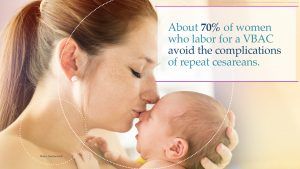
The evidence for the safety of VBAC is clear. Guidelines exist for physicians and hospitals to provide care for women who choose to labor for a VBAC. About 70% of women who labor for a VBAC give birth safely. Yet, there seems to be a lack of will to change current practice and support women’s choice for VBAC. Many hospitals in the U.S. choose not to provide care for women who want to labor for a VBAC. In 2014 only 12% of U.S. women had a VBAC.
The downstream effects of repeat cesareans put mothers and babies at increased risk for complications. Support for VBAC minimizes these harms.
Find out more from the VBAC Education Project
Women have a right to receive high-quality, evidence-based, respectful care in their childbearing year.
Women have a right to complete and accurate information to help them make an informed decision about how they want to give birth.
Women have a right to give birth without major surgery.
Women have a right to give birth without being put at risk for uterine rupture.
Women have a right to give birth without being put at increased risk for postpartum infection.
Women have a right to give birth without being put at increased risk for placental complications: placenta previa, placenta accreta, increta, and percreta.
Women have a right to give birth without being put at higher risk for hemorrhage and blood transfusion.
Women have a right to give birth without being put at increased risk for a hysterectomy.
Women have a right to give birth without being put at increased risk for needing admission to an intensive care unit.
Women have a right to give birth without being put at risk for bowel obstruction.
Women have a right to give birth without being put at risk for a blood clot in the legs or lungs that can be life-threatening.
Women have a right to give birth without being put at risk for surgical injuries to internal organs and adhesions (internal scar tissue that forms between tissues and organs).
Women have a right to give birth without being put at increased risk for cesarean scar ectopic pregnancy, fetal malformations, miscarriage, low-birth-weight, premature birth, and still birth in a future pregnancy.
Women have a right to give birth without being put at increased risk for psychological stress, anxiety, and post-traumatic stress disorder.
Women have a right to give birth without putting their baby at increased risk for surgical injury, respiratory complications, and the need for admission to a neonatal intensive care unit (NICU).
Women have a right to give birth so that their babies experience labor and are primed to receive beneficial microorganisms from their mothers which play a key role in the development of their immune system.
Women have a right to benefit from a healthy birth and the innate birth hormones which prepare mother and baby for skin-to-skin after birth, mother-infant attachment, and successful breastfeeding.
Women have a right to give birth without the added financial burden of a 30% increase for the cost of a cesarean.
Women have a right to give birth without medical malpractice companies pressuring hospitals and administrators to close their VBAC services.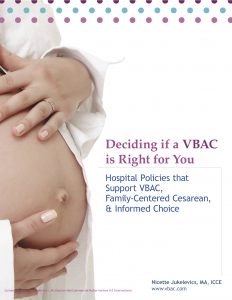
Women have a right to give birth without liability insurers imposing a surcharge on physicians who want to support VBAC.
Women have a right to labor for a VBAC and to reduce their own and their infant’s exposure to short- and long-term complications associated with routine repeat cesareans.
Resources
For sample VBAC-friendly hospital policies, birth options, and informed-decision documents with permission to reprint download Hospital Policies that Support VBAC, Family-Centered Cesarean, and Informed Choice


Is it possible to have a vaginal birth after two cesarean sections?
Yes, Sharon. It’s possible to plan a VBAC after two cesareans if you have a low horizontal uterine scar.