
Many mothers have given birth to heavier babies vaginally after a cesarean for a “big” baby. How you are cared for during pregnancy, labor and birth can make a big difference.
Estimated Fetal Weight in Pregnancy is Often Inaccurate
Care providers are concerned about vaginal birth for a potential “big” baby (fetal macrosomia) because as fetal birth weight increases so do the risks for shoulder dystocia, vaginal tears, and permanent nerve injury to the newborn. Macrosomia is defined as a suspected birth weight of 8lbs. 13 oz. or more. The problem is that estimating the size of the baby during pregnancy has been shown to be inaccurate. In the U.S. one out of ten babies are big at birth, but a national survey found that one in three women were told during pregnancy that their baby was too big for a vaginal birth.
Ultrasound estimates of fetal weight are not always accurate. ACOG discourages care providers from recommending an ultrasound in the third trimester to estimate the size of the baby or recommending a cesarean because the baby is “too big.” The Royal College of Obstetricians and Gynaecologists in Britain suggests that the majority of “big” babies do not develop shoulder dystocia and 48% of newborns who develop shoulder dystocia weigh less that 9lbs. 14 oz. The Society of Obstetricians and Gynaecologists of Canada state that suspected microsomia is not a reason to discourage mothers from planning a VBAC.
Helpful Positions for Labor and Birth
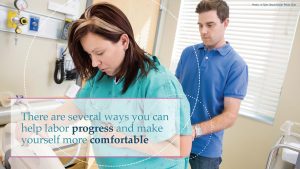
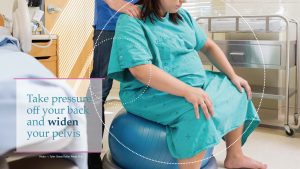
Having the freedom to walk around, staying upright during labor and using comfort measures can make a difference.
A woman’s body changes to prepare her for pregnancy and birth. Connective tissues soften in the joints. 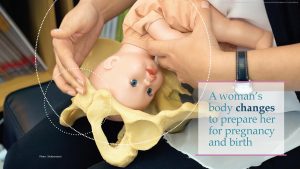 The pelvis, cervix, and vaginal tissues expand to accommodate the baby. The baby’s head molds as it moves through the mother’s body. Knowing how to move your body and change positions during labor and birth can reduce your pain and help labor progress. Specific positions such as squatting for birth can widen the pelvic diameters and allow a “big” baby to move through the pelvis with ease.
- Walk, move about, and stay upright during labor.
- Change positions to make yourself more comfortable.
- Use pillows to support every part of your body.
- Avoid an epidural in early labor which can make it more difficult for your baby to move through your pelvis and turn into a favorable position for birth.
- Give yourself enough time to reach full dilation . Current evidence shows that women are not considered to be in the active phase of labor until the cervix widens to 6cm and the membranes have ruptured.
- Push your baby down when you feel the urge rather than immediately after reaching 10cm (laboring down). Mothers who have had a vaginal birth can take up to 2 hours and with a prior cesarean without labor, 3 hours to give birth. All mothers need an additional hour if an epidural is still effective.
- Ask your childbirth educator about movements and positions for labor and birth that can help to widen your pelvis. You can download the Optimal Positions Labor Guide from BirthTools.org for examples of helpful positions for laboring with a “big” baby.
- Consider hiring a doula to support and guide you. Doulas are familiar with comfort measures and non-drug options for pain relief. Women who are supported by doulas have fewer cesareans.
- Consider having a midwife as your primary caregiver. With midwifery care, women have fewer cesareans.
Resources
Evidence-Based Birth: The Evidence for Induction or Cesarean Section for a Big Baby
VBAC Education Project: Download Module 5 of  Deciding if a VBAC Is Right for You: A Parent’s Guide and Educational Handouts for Parents: A Parent’s Guide for additional guidance on planning a VBAC.



0 Comments