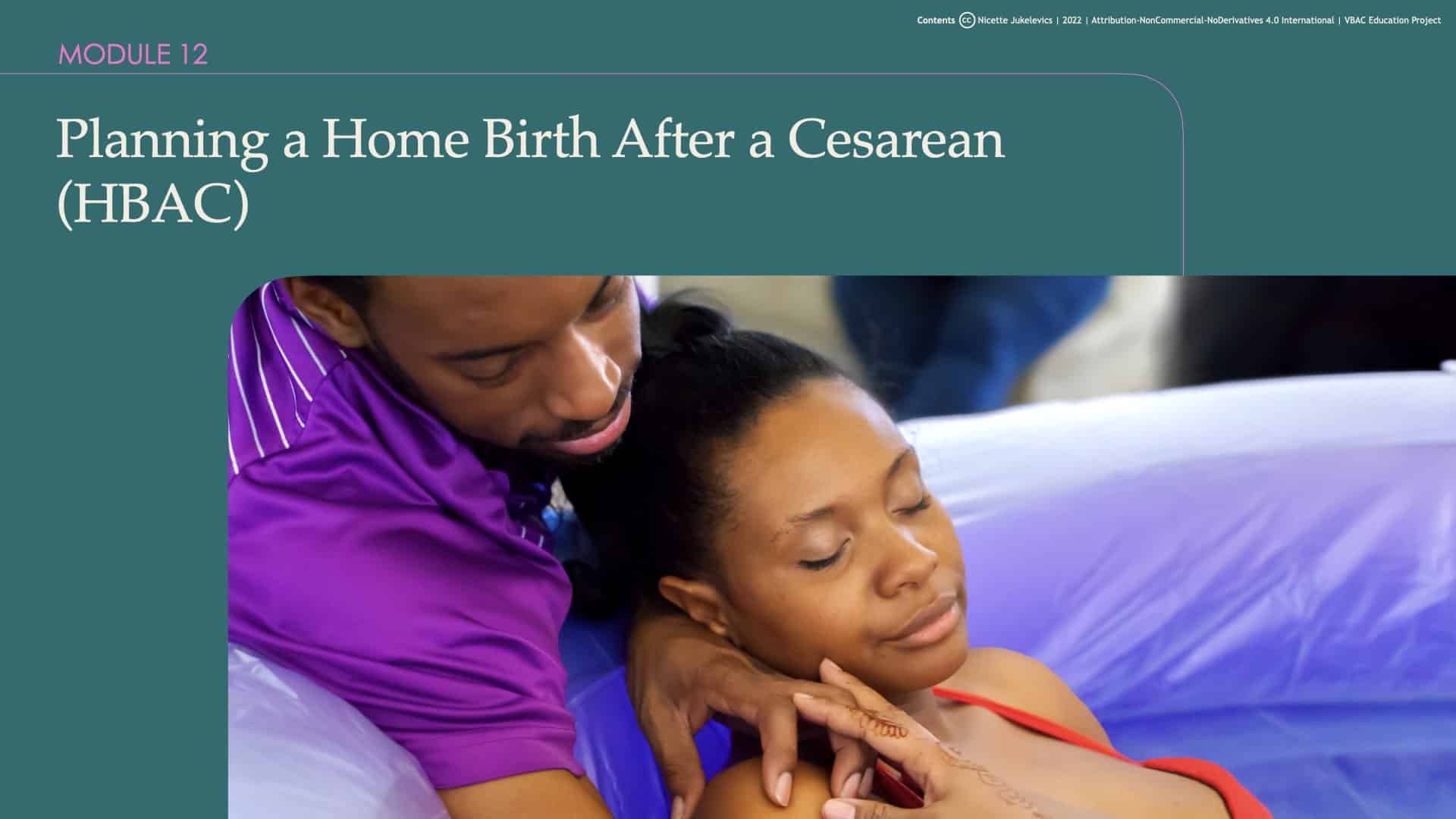
We are happy to announce the release of Module 12: Planning a Home VBAC, (HBAC), the latest addition to our free, comprehensive parent education series on vaginal birth after cesarean (VBAC). While mothers who labor at home have the highest rate of VBAC, evidence suggests that in the United States, laboring at home with a prior cesarean scar may put babies at higher risk. This module explores the benefits and risks of planning a home birth after a previous cesarean and how to evaluate the maternity care available in your community. You can download the PDF from vbac.com .
A study found that low-risk women who planned to give birth at home experienced fewer interventions and complications, including lower rates of cesarean sections, instrumental vaginal births, epidural analgesia, and episiotomies. They also had a lower risk of experiencing perineal tears, maternal infection, and postpartum hemorrhage.
However, when laboring at home for a VBAC, babies do not fare as well.
So why do some families choose a home VBAC? For many, the decision stems from a desire for a low-intervention birth experience in a comfortable, psychologically safe, and intimate environment. Some birthing families opt for a home VBAC to avoid the complications of an unnecessary repeat cesarean, which may be the only option available in a hospital setting. Others choose home birth to avoid reexperiencing a prior traumatic hospital birth.
The majority of home birth practitioners are midwives. Midwives provide one-to-one continuous clinical care and psychological and emotional support for pregnancy, childbirth, and postpartum. Many families appreciate the personal attention and values of the midwifery model of care. It is based on the perspective that birth is a physiological process that requires little intervention and that the values and needs of birthing families should be respected. With midwives, mothers have fewer cesareans and more VBACs.
Interest in home birth in the United States is increasing. In 2017 alone, 0.99 percent of all births took place at home, with a higher percentage of planned VBACs occurring at home compared to birth centers and hospitals.
Home birth has been a topic of debate in many countries, including the United States, where professional perspectives vary on the safety of this option. The American College of Obstetricians and Gynecologists (ACOG) considers hospitals and accredited birth centers as the safest settings for low-risk birth. Although it respects parents’ right to choose a home VBAC, the College considers it unsafe. There are differing opinions among midwifery and obstetric associations regarding home birth and specifically a home VBAC.
Studies from countries with integrated healthcare systems, where midwives are included across the maternity care spectrum, have shown no significant differences in perinatal mortality, neonatal mortality, or the need for newborn resuscitation between home and hospital births for low-risk pregnancies.
However, it’s important to acknowledge that in the United States, where healthcare is fragmented and midwives are not nationally integrated, neonatal mortality rates have been found to be higher for home births compared to hospital births.
In the United States, access to home birth and midwifery care for VBAC varies from state to state. The coordination of care between midwives, physicians, and hospitals is not consistent and it’s difficult to assess the safety of a home VBAC.
Expectant parents thinking about a home VBAC will find Planning a Home VBAC, (HBAC) helpful in evaluating the safety of their birth options, the different credentials of their home caregivers, and what a “seamless” transfer to hospital care looks like if it becomes necessary. Parents will find a list of helpful questions to ask their caregivers when planning a home birth and guidance on which mothers and birthing families are least likely to encounter complications while laboring with a prior cesarean scar.
We recognize that safety is of utmost importance to you as expectant parents and Module 12 addresses the safety concerns associated with home birth after a prior cesarean.

I would like to be certified as a woman health rehabilitation physical therapist
thank you sooooo much